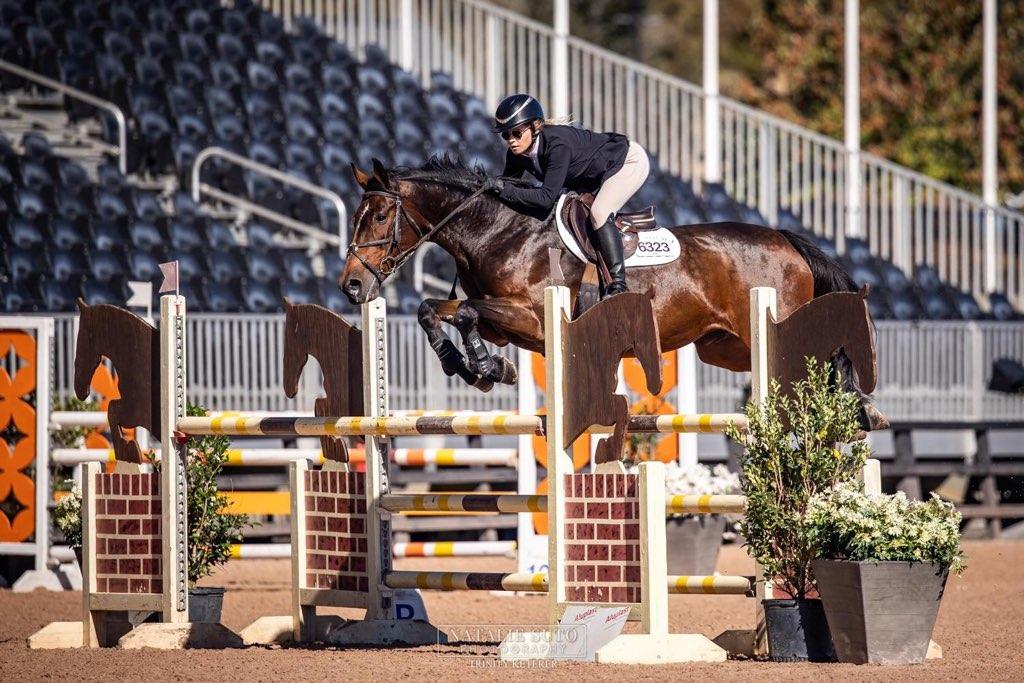
I did not grow up around horses and find them intimidating. Still, with that disclaimer, I am going to tell you about a show jumping event I attended at the Tryon International Equestrian Center (TIEC) in Mill Spring, North Carolina. That is the first thing to know: TIEC is not actually located in Tryon but in nearby Mill Spring. There is some fascinating history behind that, but the current state-of-the-art facility, started in 2014, includes 13 arenas, lodging (hotel, cabins, and RV space), a grocery store, high-end shops, and multiple restaurants. It attracts world-class riders and hosts non-equestrian entertainment, such as concerts, festivals, and youth sports, throughout the year.
We traveled there in mid-October to see our daughter-in-law, Sarah, compete in several jumping events. Sarah grew up in an equestrian family, so show jumping is in her blood. (Her mother participated in the 1988 Olympics, and her father competed in the steeplechase.) Our daughter, Leah, serves as her “groomer” on these trips, helping to feed, bathe, and muck out stalls. Given the expense, we did not stay at the TIEC but in Airbnb cabins several miles away. (Aside: One cabin was called “Yogi” and the other “Boo Boo.” If you are my age, you might remember the Hanna-Barbera cartoons featuring this mischievous Jellystone Park duo.)
Sarah and Leah drove down from Richmond, VA, with three horses: Archer, Indy, and Kally. Show horses have both a barn name and a show name. For instance, Kally’s show name is Carantec AR Tropig. Carnatec is a small seaside town nestled along the northern coast of Brittany, France, and has lovely beaches. Since Kally is originally from France and is a very striking black mare, it seemed a fitting title. Plus, it is not a name that is likely to be duplicated anywhere else in the equestrian world.
Indy (aka: Assemblyman) was born and bred as a racehorse in Lexington, Kentucky at the headquarters of Sheikh Mohammed’s US Headquarters. (The Sheik has several Godolphin operations around the world). So you could say he is from royalty. Sarah obtained him after his racing days were over as part of a rehoming program. Archer (show name: Absolute) was also bred as a racehorse; he is the youngest and still in training as a show jumper.
Walking around the facility, you need to be careful not just of passing horses but also cars, trucks, golf carts, scooters, and e-bikes. Why scooters and e-bikes? With 13 arenas spread over 1600 acres, riders and their entourages need to be able to navigate the grounds quickly, especially if they are competing with several horses in several different competitions. Of course, when a rider is competing, she arrives on horseback; however, members of her retinue require alternative transportation.
Each day, the competitions got more competitive and the stakes higher. Being able to afford an expensive, well-bred horse is half the battle. (I read online that the most expensive horse ever bought cost $15 million!) Then there are all the attendants the wealthy can bring to help feed and care for the horses. Jessica Springsteen (yes, Bruce’s daughter!) was present and fit in this elite category. Teams came from all over the world, including Belgium, Germany, France, Saudi Arabia, and Australia. Obviously, shipping horses all the way from those countries is not cheap, so the purse for winning has to be substantial. I believe the top prize money increased to $250,000.
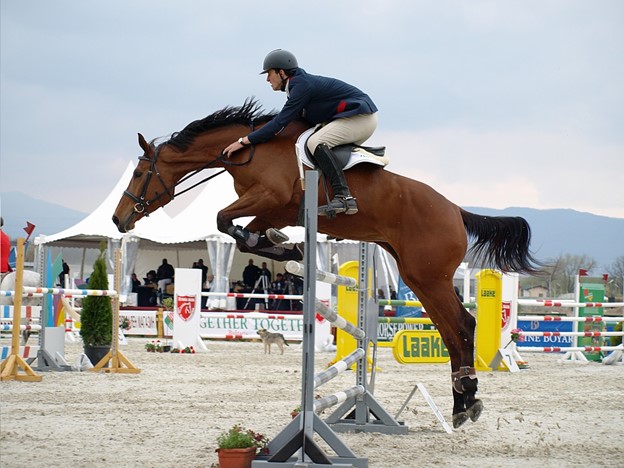
Sarah and Kally took first prize in the opening competition, and it was exciting to see them pose at the winner’s circle. Sarah made it look easy, but three things go into the final score. First, the rider must memorize the course because the jumps are laid out in various configurations within the arena. There are generally two types of jumps, verticals (a single fence) or oxers (a wider jump with two or more sets of rails). If you mess up by taking the wrong jump at the wrong time, you are disqualified. And even if you memorize the course, you need to know the number of “horse” steps between jumps so your stallion or mare soars over them at the right point. Second, you lose four points for every knocked-down rail. It is heartbreaking to watch a horse and rider sail over 15 jumps, only to hit a rail on the last attempt.
Finally, if multiple riders complete the course without faults (no knocked rails or other penalties), the competition between them is decided by a jump-off. This is a second, shorter round, where riders compete to finish with the fastest time while still remaining clear. Since it takes place immediately after the first run, the rider must memorize two different courses before entering the ring.
Another thing I learned is that horses, like people, all have their own unique personalities. Sarah says she can tell a horse’s disposition by its eyes. (Yes, she is a horse whisperer.) Some are easygoing, some aggressive, and others cocky. Kally is extremely talented but a bit of a perfectionist. Indy has a lot of experience with crowds and acts pretty chill. Though strong and muscular, Archer is still mastering the discipline required of a show jumper. Owners must play the long game, hoping that their training, love, and care will ultimately yield a winner.